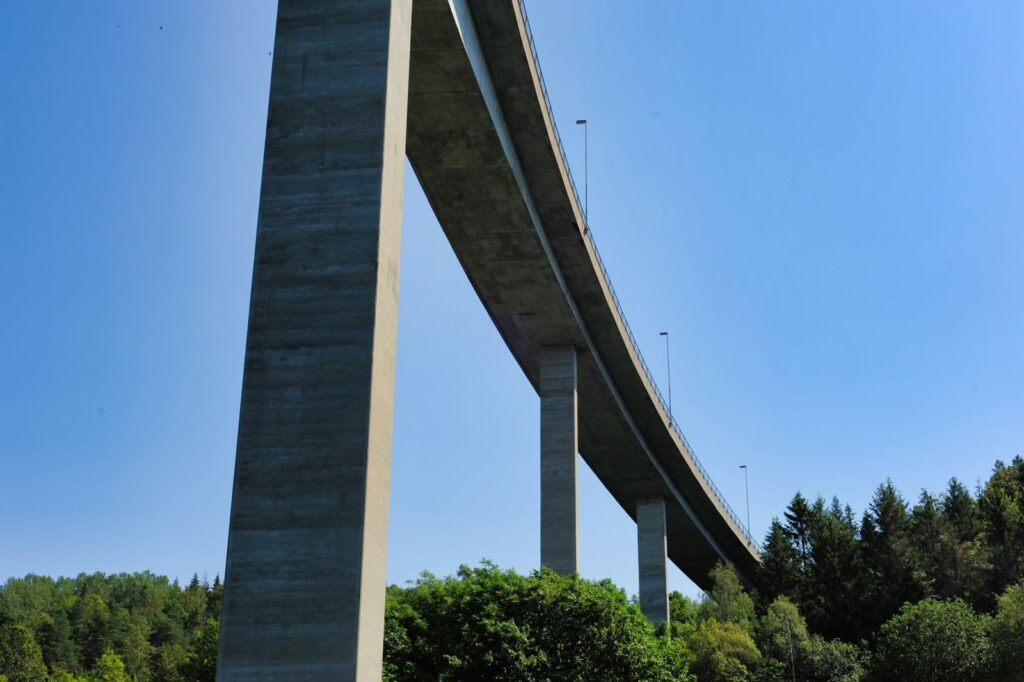
Asphalt surfacing on a bridge deck looks like a waterproof layer, but it is not. Water passes through asphalt, especially as it ages and cracks, and on roads that are salted in winter that water carries chlorides. Without a membrane between the surfacing and the concrete, the deck slab and its reinforcement are exposed to the conditions most likely to cause corrosion.
This guide explains why bridge decks are waterproofed, the main membrane types, how the membrane works with the asphalt above it, where detailing matters and how installations are checked. It is general information. Membrane selection and specification for a real bridge is the responsibility of the bridge owner and qualified engineers, using the manufacturer’s data and the highway authority’s standards and approval requirements.
Key takeaways
- Asphalt surfacing is not waterproof; a membrane underneath protects the deck from water and chlorides.
- Sheet membranes give factory-controlled thickness but have laps and are harder to detail around complex shapes.
- Liquid and spray-applied membranes have no laps and adapt to shape, but thickness depends on site control.
- The membrane must survive hot asphalt placement and bond to the surfacing so it does not slip or shove under traffic.
- Detailing at joints, drains, curbs and parapets is where most leaks start.
- Many highway authorities approve membranes through their own schemes; follow the owner’s specification.
Why decks need membranes
Concrete bridge decks are exposed to water from above, and on many roads to de-icing salts. Chlorides dissolved in that water penetrate the concrete and, once they reach the reinforcement in sufficient concentration, cause corrosion. Rusting steel expands, cracks the concrete and leads to delamination and potholes in the deck. Our guide to why concrete deteriorates explains the mechanism.
Repairing a deck means closing lanes, removing surfacing and breaking out concrete, often under traffic management at night. Preventing water and salt from reaching the deck in the first place is usually much cheaper over the life of a bridge, which is why many highway authorities require deck waterproofing on new bridges and when surfacing is replaced.
A membrane also protects against freeze-thaw damage by keeping the deck concrete from becoming saturated, and on decks without asphalt it may be part of an exposed traffic-bearing system.
The layers on a typical deck
| Layer | Function |
|---|---|
| Concrete deck | Structural slab, prepared to a clean, sound, profiled surface |
| Primer | Seals pores, reduces outgassing, improves adhesion |
| Waterproofing membrane | Keeps water and chlorides out |
| Bond coat or tack coat | Bonds the membrane to the asphalt, resists shear from traffic |
| Protection layer (some systems) | Protects the membrane from paving equipment and hot aggregate |
| Asphalt surfacing | Running surface, often in two layers |
| Sub-surface drainage | Removes water that collects on top of the membrane under the asphalt |
Not every system uses every layer; the manufacturer and the owner’s specification determine the build-up.
Membrane types
Preformed sheet membranes
These are factory-made sheets, commonly polymer-modified bitumen reinforced with a polyester or glass carrier. They are bonded to the primed deck by torching, by hot bitumen or by self-adhesive backing, and laps between sheets are sealed.
- Strengths: consistent thickness controlled in the factory; long history of use; relatively tolerant of rougher surfaces; simple equipment.
- Considerations: laps are potential leak paths; detailing around drains, upstands and irregular shapes takes skill; torch application has fire risk; blistering can occur if moisture is trapped beneath; sheets can be displaced or creased by traffic and paving equipment before surfacing.
Liquid and spray-applied membranes
These are applied as liquids and cure in place to form a continuous film without laps. Common chemistries include:
- Spray polyurethane and polyurea: fast curing, elastomeric, no laps; require plural-component spray equipment and careful primer selection. See what is polyurea.
- Methyl methacrylate (MMA) resins: very fast curing even at low temperatures, often spray-applied in two coats of contrasting color to help check coverage.
- Hot-applied rubberized asphalt: melted on site and applied in thick layers, usually with a reinforcing fabric and a protection sheet.
- Bitumen-based emulsions and other cold-applied liquids: used in some systems and regions.
Strengths include continuous coverage without laps, adaptability to complex geometry, quick application over large areas with spray equipment and in many cases fast cure that suits short closures. Considerations include the need to control thickness on site, sensitivity to surface preparation and moisture, and the need to choose a membrane that is compatible with the asphalt and its placement temperature.
Comparing the approaches
| Factor | Sheet membrane | Liquid or spray-applied membrane |
|---|---|---|
| Thickness control | Set in the factory | Depends on application control and testing |
| Seams | Laps that must be sealed | None; continuous film |
| Complex details | Cut and fitted; slower | Applied directly; usually easier |
| Weather sensitivity | Moderate; damp surfaces cause blistering | Varies by chemistry; dew point and substrate moisture critical |
| Speed | Moderate | Often fast, especially with spray equipment |
| Equipment | Torches, rollers or hot kettles | Spray rigs, mixers or kettles depending on system |
There is no universally better choice. Many authorities allow either, provided the specific system is approved for the purpose.
Preparing the deck
The membrane is only as good as the surface beneath it. Typical requirements include:
- Age and moisture of new concrete. Fresh concrete contains a lot of water. Applying a membrane too early can cause blistering or poor adhesion. Specifications often set a minimum concrete age, a moisture limit or both; check the manufacturer’s data sheet and the owner’s specification.
- Removal of laitance and contamination. Shot blasting is commonly used on decks to remove laitance, curing compounds, oil and old material and to produce a surface profile the manufacturer specifies (often described on the ICRI CSP scale).
- Repairs. Defects, holes, sharp ridges and spalls are repaired with compatible materials before priming.
- Pull-off adhesion tests on the prepared concrete confirm that the surface is strong enough.
- Weather and dew point. Surface temperature typically needs to be a margin above dew point (a few degrees is a common requirement) to avoid condensation; follow the data sheet.
Bond to the asphalt surfacing
The membrane sits between two rigid layers and has to transfer traffic forces between them. If the bond between membrane and asphalt is weak, the surfacing can slide, shove or crack, especially on gradients, at braking zones and at junctions.
Points to consider:
- Bond coats or tack coats specified by the membrane manufacturer improve adhesion to the asphalt. Some membranes are designed to bond directly to hot asphalt.
- Temperature resistance. Hot-mix asphalt is placed at high temperature, and mastic or gussasphalt surfacing used in some countries is hotter still. The membrane, primer and bond coat must tolerate those temperatures without blistering, softening excessively or losing adhesion. Typical placement temperatures and the membrane’s tested limits are given in the manufacturer’s data and the paving specification.
- Mechanical damage. Paving machines, trucks and hot aggregate can puncture or tear a membrane. Some systems include a protection layer; others rely on careful paving practice, such as avoiding sharp turns of tracked equipment on the membrane.
- Blistering. Moisture or air trapped in or beneath the membrane can expand under hot asphalt, raising blisters. Correct concrete moisture, primers that seal the surface and suitable weather reduce the risk.
Cure before paving
Liquid membranes need to reach a defined state of cure before the bond coat and asphalt are applied. Fast-curing polyurea and MMA systems may be ready in a short time, sometimes under an hour, while other systems need much longer, depending on temperature. Paving too early can damage an under-cured film; leaving the membrane exposed too long can allow contamination, UV exposure or damage from site traffic. Follow the manufacturer’s minimum and maximum times and keep the surface clean until paving.
Detailing
Most deck leaks start at details, not in the middle of the membrane. Our guide to waterproofing joints, penetrations and terminations covers the same problem on other structures.
- Expansion joints: the membrane must be terminated or connected to the joint system so water cannot pass behind it. Joint manufacturers and membrane manufacturers often specify compatible details.
- Drains and outlets: the membrane should be turned down into the drain body or clamped under a flange so water on top of the membrane can escape. Without that, water ponds within the asphalt.
- Sub-surface drainage: water that penetrates the asphalt collects on the membrane and runs to low points. Small drains or drainage channels at low points and along curbs remove it.
- Curbs, parapets and upstands: the membrane is usually carried up the vertical face to a termination above the surfacing level, with a sealed top edge.
- Penetrations: lighting columns, sign posts, ducts and barrier fixings all need individual details.
- Transitions: where the deck meets approach slabs, abutments or a different system, the overlap and compatibility must be detailed.
- Construction joints in the membrane: where work is done in sections, the overlap or joint method follows the manufacturer’s procedure.
Testing and quality control
| Check | Purpose |
|---|---|
| Concrete surface moisture and temperature, air temperature, humidity, dew point | Confirm application conditions are within limits |
| Surface profile and cleanliness | Confirm preparation meets the specification |
| Pull-off adhesion on concrete | Confirm surface strength before priming |
| Wet film gauges, material consumption and dry thickness checks | Confirm thickness for liquid systems |
| Adhesion of membrane to concrete | Confirm bond after cure |
| Visual inspection and, for some systems, holiday or spark testing | Find pinholes, blisters and defects |
| Lap inspection for sheets | Confirm seams are sealed |
| Bond tests between membrane and asphalt | Confirm shear and tensile bond where specified |
Records of conditions, materials used, batch numbers and test results are typically required by the owner and are valuable later if problems appear.
Standards and approvals
Many highway authorities maintain approval schemes, product lists or specifications for bridge deck waterproofing, often with their own test regimes for adhesion, crack bridging, resistance to hot asphalt and durability. In Europe, harmonized product standards exist for some membrane types. Follow the owner’s specification and use a system approved for the specific use. Our comparison of protective coating systems covers the generic chemistries in more detail.
Bottom line
A bridge deck membrane keeps water and de-icing salts away from the concrete that the asphalt cannot protect. Sheet membranes offer factory-controlled thickness; liquid and spray-applied membranes offer continuous, lap-free coverage and easier detailing. Either works only with a properly prepared and dry enough deck, a reliable bond to the surfacing, careful paving and attention to every joint, drain and upstand. Use a system approved by the highway authority, follow the manufacturer’s data sheet and let qualified engineers specify and inspect the work.