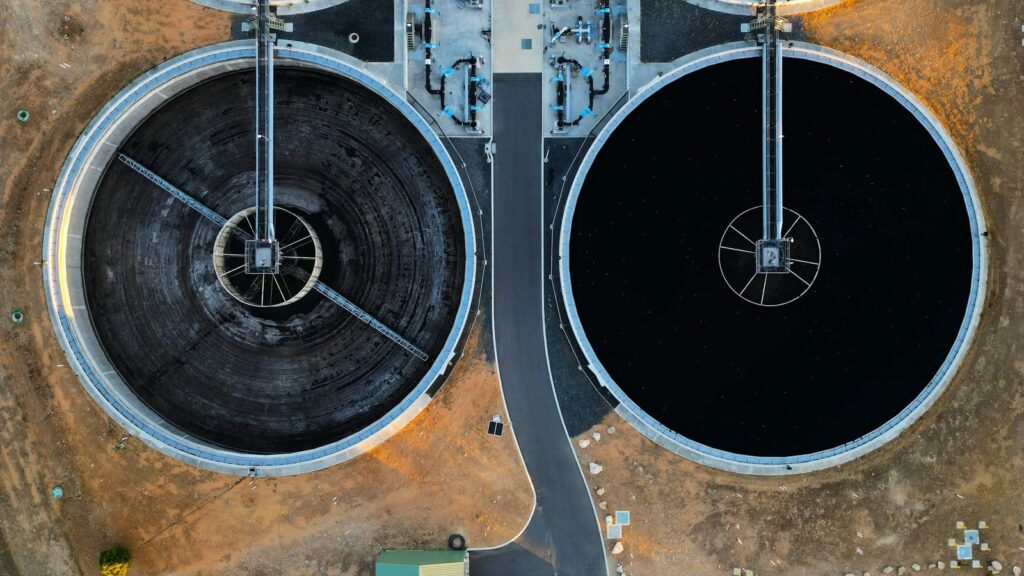
Concrete in sewers, wet wells, manholes and wastewater treatment structures can be destroyed from the inside out. The water itself is often not the main problem. The damage usually happens above the water line, where gases from the wastewater meet moist concrete and bacteria turn them into sulfuric acid.
This guide explains how that corrosion works, where it is worst, the main lining options and what makes a lining succeed or fail: preparation, moisture, thickness and testing. It also covers why tanks for drinking water need certified materials. It is general information. Lining selection for a real structure needs a condition assessment, a qualified engineer or coatings specialist, the manufacturer’s data and the standards and owner specifications that apply.
Key takeaways
- Hydrogen sulfide from septic wastewater is oxidized by bacteria on moist concrete surfaces into sulfuric acid, which dissolves cement paste.
- Lining options include epoxies, polyureas and polyurethanes, embedded PVC or HDPE liners, and calcium aluminate or other specialized mortars.
- Surface preparation must reach sound, uncontaminated concrete, which often means removing a lot of softened material and rebuilding the surface.
- Moisture and outgassing are the most common causes of blistering and pinholes in linings on concrete.
- Holiday testing finds pinholes and gaps in linings before the structure returns to service.
- Tanks storing drinking water need lining materials certified for potable water contact, such as NSF/ANSI/CAN 61 in North America.
How corrosion happens in wastewater structures
Hydrogen sulfide generation
In wastewater with little or no dissolved oxygen, sulfate-reducing bacteria in slimes and sediments convert sulfate to sulfide. Conditions that favor this include long retention times, warm temperatures, low flow velocities, force mains (pressurized pipes with no air) and high-strength wastewater.
When that wastewater is agitated, at drops, turbulent inlets, pump discharges and force main outlets, hydrogen sulfide gas is released into the air above the water.
Biogenic sulfuric acid
Hydrogen sulfide gas dissolves in the moisture film on the concrete above the water line. Sulfur-oxidizing bacteria living in that film convert it to sulfuric acid. As the surface becomes more acidic, different bacterial species take over, and the surface pH can become strongly acidic.
The acid reacts with the cement paste, forming soft products such as gypsum that have little strength and can expand. The concrete surface turns soft and pasty, aggregate becomes exposed and loosens, and section is lost over time. Once reinforcement is reached, it corrodes as well. Our guide to why concrete deteriorates places this mechanism among the others.
Where to look
| Location | Why it is vulnerable |
|---|---|
| Crowns and upper walls of sewers | Gas collects, moisture condenses, little washing by flow |
| Wet wells and pump stations | Water level fluctuates, turbulence at inlets, long retention |
| Force main discharge manholes | Septic wastewater released with high turbulence |
| Headworks and grit chambers | Turbulence and screening release gases |
| Covered tanks and channels | Gas trapped under covers |
| Junctions and drops | Turbulence releases gas |
Concrete below the normal water level is usually much less affected, because the acid-forming bacteria need air and a moist surface rather than full immersion.
Lining options
Each option has a place. The choice depends on the severity of attack, the structure’s condition and geometry, how long it can be taken out of service and what the owner’s specification requires.
Epoxy linings
Two-component epoxies, including 100% solids and novolac grades for stronger acid resistance, are widely used. They are applied by spray or trowel, sometimes over a cementitious resurfacing layer.
- Strengths: strong adhesion to prepared concrete, good acid resistance with suitable grades, long history in wastewater service.
- Considerations: rigid, so cracks that move can reflect through; cure slows in cold conditions; some grades are sensitive to moisture on the substrate.
Polyurea and polyurethane linings
Spray-applied elastomers cure quickly and bridge cracks. See what is polyurea for the chemistry.
- Strengths: fast return to service, which matters when bypass pumping is expensive; continuous film without seams; crack bridging; build thickness quickly on walls and overhead.
- Considerations: chemical resistance varies widely between products, especially between pure and hybrid polyurea; resistance to concentrated sulfuric acid must be confirmed with the manufacturer’s data for the specific exposure; very sensitive to substrate preparation, moisture and outgassing.
Embedded PVC or HDPE liners
Thermoplastic sheets with anchoring ribs or studs on the back are cast into new concrete or mechanically fixed and grouted in rehabilitation. Seams are welded.
- Strengths: high resistance to sulfuric acid; factory-controlled thickness; seams can be tested.
- Considerations: cast-in liners need to be planned at the design stage; detailing at penetrations and terminations is critical; repairs need welding by trained personnel.
Calcium aluminate and other specialized mortars
Calcium aluminate cement mortars, often with calcium aluminate aggregates, are used to resurface and rebuild manholes and wet wells. They are widely reported to perform better than ordinary Portland cement in biogenic acid environments, partly by resisting acid chemically and partly by limiting bacterial activity on the surface. Geopolymer and other specialized mortars are also used. Our guide to manhole rehabilitation options compares these mortars with resin linings, inserts and liners.
- Strengths: cement-based, tolerant of damp substrates, can rebuild lost section and line in one operation, often spray-applied.
- Considerations: not immune to severe acid attack; performance depends on product, thickness and exposure severity; check the manufacturer’s data and the owner’s experience in similar conditions.
Comparing options
| Option | Acid resistance | Crack bridging | Tolerance of damp substrate | Return to service |
|---|---|---|---|---|
| Epoxy (suitable grade) | Good to very good | Low | Low to moderate (special grades) | Hours to days |
| Polyurea or polyurethane (suitable grade) | Varies widely; confirm | High | Low | Minutes to hours |
| Embedded PVC or HDPE | Very good | Bridges by spanning, if anchored | Not applicable (cast or grouted) | Depends on grout or concrete |
| Calcium aluminate mortar | Better than Portland cement; not immune | Low | High | Hours to days |
The table shows general tendencies. Individual products differ, so use the manufacturer’s data for the specific product and exposure. Our comparison of protective coating systems covers the generic families.
Surface preparation and moisture
Remove what is damaged
Acid-attacked concrete is soft and contaminated with sulfates and acids. Linings applied over it fail because the substrate itself fails. Preparation typically means:
- High-pressure or ultra-high-pressure water jetting, or abrasive blasting, to remove all soft and contaminated material down to sound concrete.
- Checking the surface pH and testing for sound, uncontaminated concrete as the specification requires.
- Removing fats, oils, grease and biological growth.
- Rebuilding lost section with suitable repair mortars, to the profile and smoothness the lining requires.
- Treating exposed reinforcement as an engineer directs.
The prepared surface needs the profile the lining manufacturer specifies, commonly expressed using the ICRI concrete surface profile (CSP) scale.
Stop active water
Groundwater leaking through cracks, joints or pipe connections will push a lining off the wall. Active leaks are typically stopped first, for example with chemical grouts injected into cracks and joints, before resurfacing and lining.
Control moisture and outgassing
Wastewater structures are rarely dry. Many linings need the substrate to meet a moisture limit, and concrete releases air and vapor as it warms. Common measures include:
- Testing substrate moisture by the method and limits the manufacturer specifies.
- Using moisture-tolerant primers or a cementitious resurfacing layer designed to be coated.
- Applying when substrate temperature is stable or falling to reduce outgassing.
- Controlling condensation with ventilation and dehumidification, keeping the surface above the dew point margin the data sheet requires.
Work safely
Wet wells and manholes are confined spaces that can contain hydrogen sulfide, methane and low oxygen levels. Work requires a confined space entry program, continuous gas monitoring, forced ventilation, rescue planning and bypass pumping or flow control. Coating materials add their own hazards, including solvents and isocyanates. Follow local occupational safety rules and the safety data sheets.
Thickness and holiday testing
A lining protects only where it is continuous. A pinhole or thin spot lets acid reach the concrete and attack it behind the lining, which can then debond.
- Thickness: wet film gauges during application, material consumption checks and destructive or ultrasonic dry thickness measurement where the specification allows.
- Adhesion: pull-off tests on test areas or witness locations as specified. ASTM D7234 is a common pull-off method for coatings on concrete.
- Holiday (discontinuity) testing: an electrical test that detects gaps in the lining. Low-voltage wet sponge testers are used for thinner films; high-voltage spark testers for thicker linings, at a voltage set according to the lining thickness and the manufacturer’s guidance. On concrete, the test relies on the concrete being conductive enough, which depends on its moisture, and some systems use a conductive primer. ASTM D4787 covers continuity verification of linings on concrete; AMPP publishes guidance for discontinuity testing.
Every holiday found should be marked, repaired according to the manufacturer’s procedure and retested. Our guide to holiday testing explains the low-voltage and high-voltage methods in more detail.
Drinking water tanks are different
Lining a tank, reservoir or pipe that holds drinking water is a separate category. The lining must not leach substances into the water that could affect health, taste or odor.
- Certification: in North America, materials in contact with drinking water are typically required to be certified to NSF/ANSI/CAN 61. Other countries have their own approval systems, such as the UK’s approval of products for use in public water supply and national schemes elsewhere in Europe.
- Product and conditions: certification applies to specific products, colors, thicknesses, cure conditions and sometimes tank sizes or water temperatures. A product certified in one configuration is not automatically certified in another.
- Cure before filling: potable water linings must be fully cured as the manufacturer specifies before the tank is filled, and the tank is then disinfected and tested according to the water authority’s procedures. In North America, AWWA publishes standards for coating steel water tanks and for disinfecting storage facilities.
- Never use a wastewater lining in a potable tank unless it carries the required certification for that use.
Planning a lining project
- Assess: inspect the structure, measure section loss and identify the causes, including gas levels and flow conditions.
- Consider the source: reducing hydrogen sulfide through ventilation, chemical dosing or hydraulic changes can extend lining life; this is a process engineering question.
- Select: choose a lining for the exposure severity, condition and allowable downtime.
- Specify: preparation, moisture limits, thickness, testing, safety and documentation.
- Install and test: with qualified crews, inspection and records.
- Monitor: inspect periodically, especially at inlets and turbulent zones.
Bottom line
Wastewater structures corrode mainly because hydrogen sulfide released from septic wastewater is turned into sulfuric acid by bacteria on moist concrete above the water line. Linings, whether epoxy, polyurea, embedded thermoplastic or specialized mortar, can protect these structures, but only on properly prepared, sound concrete with moisture under control, at the specified thickness and without holidays. Potable water tanks need certified materials and their own cure and disinfection procedures. Specification belongs to qualified engineers using manufacturer data and the applicable standards.